This visualization is a bit different than the others. We sought here to test whether there was a “backbone” or “skeleton” in the highly connected citation network. We did that by extracting the ten rabbis with the highest combined number of citations (that is, number of individual rabbis cited plus number of individual rabbis citing them). Since it was far smaller, we were able to use English names and indicate the directionality on the static diagram below. Note that in a few cases rabbis cite each other. More interesting is how highly connected these ten rabbis were.
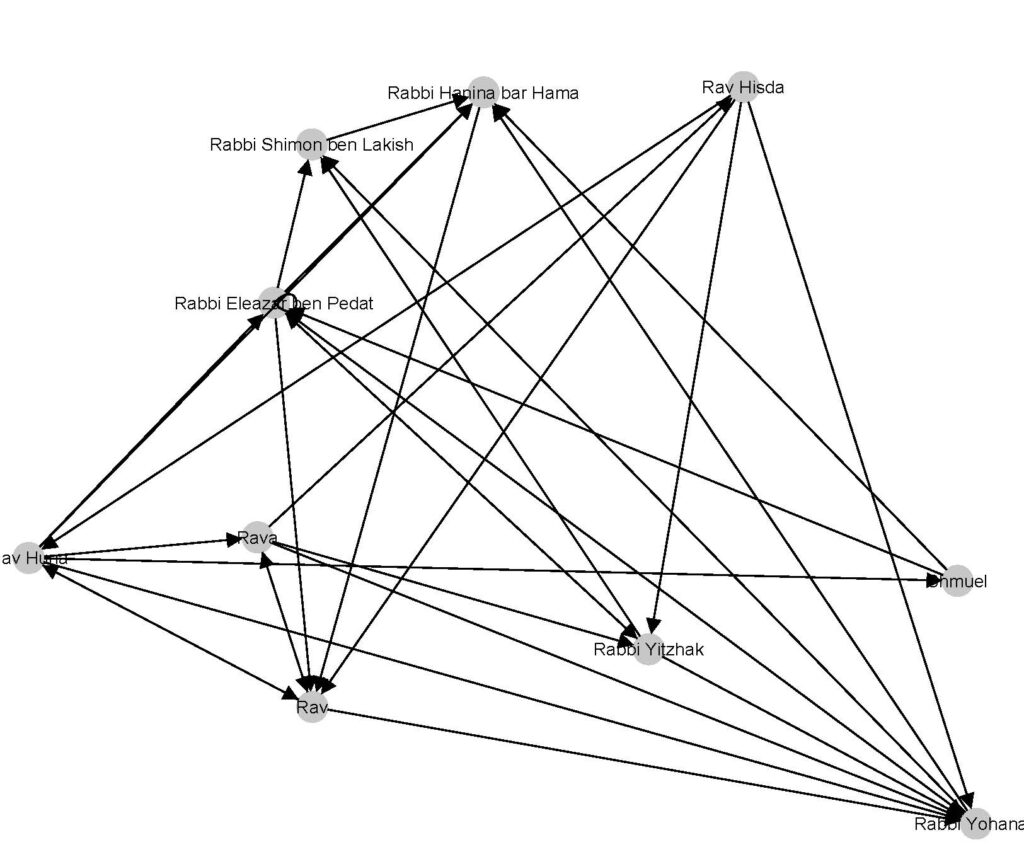
The interactive version is below. A few words about how to use it:
- Each black dot is a single, unique rabbi. To see the name of a rabbi, you can hover over the dot. The buttons in the bottom center will zoom the diagram in and out and reset it to the original view. You can also use the mouse-wheel to zoom. Right clicking and dragging will allow you to pan the diagram. Note that when you zoom in the names will begin to appear.
- If you click on a rabbi, that rabbi will appear with all of his connections, that is, rabbis who either he cites or who cite him. In the panel that appears on the right, you will see each of these other rabbis. You can click into them to explore their own networks further. When you want to reset everything and return to the original network, click the X by the “Return to the full network” legend on the top.
- To use the search feature in the panel on the left, simply type in type part of a name; all names that contain that string will appear.
Explore, and let us all know if you have any insights on this page.

Reb Yochanan has always fascinated me as he quotes Reb Shimon Bar Yochai a lot.
Now one of them lived 300 years before the other. The question is how can Reb Yochanan be quoting someone who lived hundreds of years before him. There are various approaches, one by seder hadoros that he lived hundreds of years! Not very likely but who knows…. I was looking to see if this tool could provide clues as to the connection between them. Since I am not that familiar with the tool I was hoping you who are might have a thought about this.
Thanks so much.
An interesting observation! It would be interesting to isolate all of those cases and see what is happening; it could always be a data mistake as well. I don’t have time to do this now (but it will go on my list), but if you come up with any hypotheses please share them here.